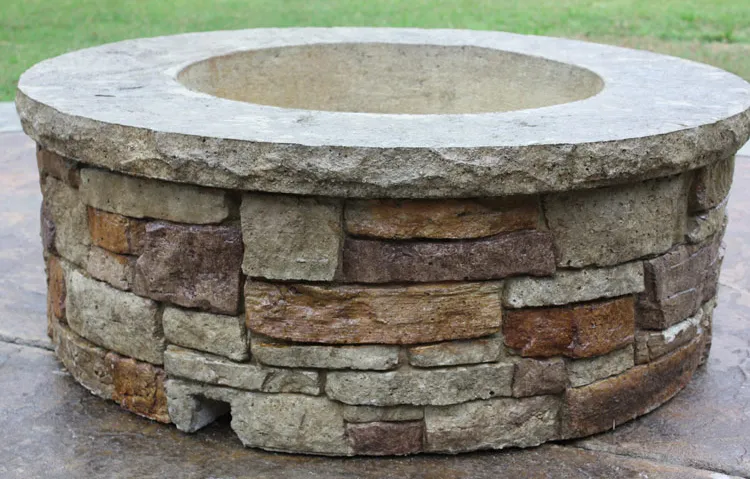
A fire pit gets most use here from October to March. We pour the pad and seating area and build lined pit rings that drain, since rain fills a solid pit fast. Check setback and burn rules with your fire department and subdivision before building.
Cool, dry evenings from October to March are when people around Gonzales use the back yard most, and a fire pit gives the patio a center. We pour the pad and the seating area, and we build poured or block-and-concrete pit rings and low seat walls. The simplest version is a round or square pad sized for a store-bought steel fire bowl with chairs around it.
Fire and concrete need a little planning. Ordinary concrete can flake or pop when it is heated hard while damp, and nothing stays dry for long in this climate. A built pit is lined with fire brick or a steel insert so flames do not sit directly on structural concrete, and the bottom is open to gravel or has a drain hole so the pit does not fill with rainwater.
Where the pit goes matters as much as how it is built. Keep it away from the house, the fence, low branches and a patio cover. Gas pits need a line run by a licensed gas fitter before we pour. We could not confirm a published setback or burn rule for the city or the parish, so check with the local fire department and your subdivision before building, and watch for burn bans in dry spells.
Concrete fire pits in Gonzales: common questions
Can I put a fire bowl straight on my patio?
A raised steel bowl on legs is generally fine on plain concrete, though heat and ash can mark the surface. On stamped or sealed concrete, use a heat shield or pavers under it, because sealer scorches and discolors.
Why does a fire pit need a drain?
With about 60 inches of rain a year, a solid-bottom pit becomes a pond that breeds mosquitoes. An open gravel base or a drain hole lets water out, and dry masonry handles heat much better.
Wood or gas?
Wood is cheaper to build and gives real heat. Gas lights at once and makes no smoke, which neighbors on small lots appreciate. Gas needs a supply line and a licensed installer, planned before the slab is poured.
How it works
- Free estimate: Call, text or book online. We visit and measure.
- Written quote: Clear pricing with finish options.
- Prep & forms: We excavate, grade, compact the base and set forms and reinforcement.
- Pour, finish & cure: We pour, finish, cut control joints and tell you when you can use it.