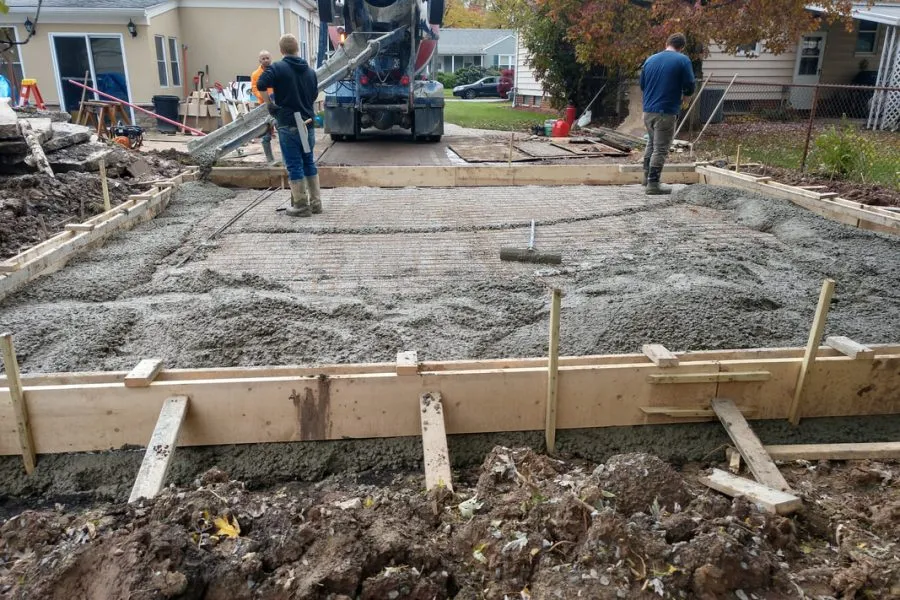
Three things damage concrete around Gonzales: clay that changes size with the weather, heavy rain on nearly flat land, and tree roots. This page covers how each one is handled.
Do I need to think about drainage before pouring concrete?
Yes, before anything else. A slab turns rain into runoff, and on a flat lot that runoff needs a planned route to the swale or the roadside ditch. We set the fall of the slab at the forming stage. We also look at gutters, because one downspout emptying beside a slab can wash out or swell the clay under it. Good drainage is the cheapest protection a slab gets.
My patio or driveway slopes toward the house. What can be done?
It can be corrected, and it should be. A slab that tips toward the house sends every storm against the wall or under the garage door. Options run from a channel drain cut along the low edge, to raising the low side, to replacing the slab with the correct fall. Which one fits depends on how far off the slope is and what caused it.
Can tree roots crack or lift concrete?
They can, and they do. Tree roots thicken a little every year and jack up the panel above them. Live oaks, water oaks and even crape myrtles planted in a narrow strip beside a drive are frequent culprits here. Clay makes it worse in drought, because roots travel under slabs where the soil stays damp.
Can I fix the concrete and keep the tree?
Usually. To keep the tree, we can ramp the new panel over the root, shift the walk a foot or two away, shorten the panels and reinforce them over the root, or grind the lip for now. Removing a major root is the last resort, since it risks killing the tree or leaving it unstable in a storm. For a valuable oak, an arborist's opinion costs little compared with the tree.
My neighbor's new concrete sends runoff into my yard. What can I do?
Begin with a friendly conversation during or just after a rain, when the path of the water is plain to see. A gutter extension, a small drain or reopening the shared swale often cures it. Louisiana's Civil Code has rules on natural drainage between neighboring properties, and in general an owner may not make the flow more burdensome for the lower lot. We have not verified the article numbers and do not cite them. If talking fails, contact parish or city drainage staff, or a lawyer. General information, not legal advice.
Does clay or soft soil change how the job is done?
It changes most of it. The clay under Gonzales swells in wet months and shrinks in dry ones. Lower ground toward St. Amant and Sorrento adds soft soil that stays wet. So we strip topsoil, dig to firm ground, place a compacted base, reinforce the slab and space joints closely. We also keep water from standing at the slab edge, because uneven moisture is what makes clay lift one side and drop the other.
My gravel driveway turns to mud every winter. Is concrete the answer?
It is, as long as the mud is dealt with first. A gravel driveway on clay fails because stone is pressed down into wet soil and soil pumps up through it. Concrete placed on that mix will settle unevenly. We remove the soft layer, lay fabric where it helps, compact a proper base and then pour. Fixing the roadside culvert and ditch is often part of the cure.
My patio was poured over an old utility trench and it has settled. Why?
Loose backfill is the reason. Soil returned to a trench for a sewer, water or electric line is seldom compacted in layers, and it sinks for years, faster in wet clay. The slab above bends and cracks along the line. The repair is to remove that strip, compact the trench properly or replace the fill, and pour again with steel tied across.
My lot floods. Should the patio or slab be raised?
Raising helps a patio drain, within limits, and in a flood-prone area the limits are legal as well as practical. Ascension Parish regulates fill through its drainage rules, and a parish notice refers to 36 inches of fill at most with a compaction test and an engineer's report. Fill also pushes water somewhere else, possibly next door. For a building, the permit sets the floor height. For a patio, we first work out where the water comes from.
What did the 2016 flood teach about concrete here?
That flood water hurts the ground more than the slab. After August 2016, sound concrete in St. Amant, Galvez and Denham Springs was still sound, but many slabs had soil scoured from under their edges or sat on fill that settled as it dried. If your slab has been under water, tap it for hollow spots and check for new dips before spending money on the surface.
Want a real number for your property? We measure on site and write the quote down, free. Call (225) 529-0954 or text a photo of the concrete.