What you build with, and how, should follow the load, the look and the ground. Around Gonzales the ground is slow-draining clay that swells and shrinks, and the weather is hot and wet. Those facts steer most of these answers.
The prices on this page are national figures that HomeGuide published for 2026. They are not quotes from The Gonzales Concrete Company. What you pay in Ascension Parish depends on local labor and material costs, how easy the site is to reach, and how much base work the clay needs. Last checked October 2026.
Concrete or asphalt for a driveway?
Most home driveways here are concrete. National figures are $5 to $12 or more per square foot for asphalt, or $2,000 to $4,800 for a 20x20, against $6 to $15 for concrete. Asphalt tolerates ground movement and costs less to start with. It also softens under a Louisiana summer sun, marks under trailer jacks and needs resealing. Concrete keeps its shape and reflects heat, provided the base, steel and joints are done properly.
Poured concrete or pavers?
National figures put a paver patio at $10 to $17 per square foot installed, or $3,800 to $6,800 for a 20x20, while a plain concrete patio is $4 to $12. Pavers can be pulled up and relaid after the ground moves. On wet clay they also rock, sprout weeds and shelter fire ants unless the base is very well built. A poured slab is one piece with no sand joints. If you want the paver look, a stamped slab is the middle road.
How thick should a concrete driveway be?
Four inches is the usual minimum for cars and light pickups. Five to six inches suits heavier vehicles, and so does the first stretch off the road where delivery trucks turn in. A loaded boat trailer, a motorhome or a work truck calls for the thicker section with heavier steel. On clay, base preparation counts as much as the extra inch.
Do I need rebar or wire mesh?
On this soil we recommend steel in every driveway and slab. Rebar or wire mesh will not prevent cracks. It keeps the two sides of a crack locked together and at the same height when the clay moves. Rebar set on chairs stays where it should during the pour. Mesh works only if it is pulled up into the concrete, and in practice it often ends up on the ground.
What PSI concrete do I need?
Home flatwork is commonly ordered at 3,000 to 4,000 PSI, which is the compressive strength at 28 days. Heavier use calls for the higher end. Engineered slabs use the PSI on the drawings. Watch the water as well as the number. Water added at the site to make the mix flow lowers the strength at the surface.
Is stamped concrete worth it?
Stamped concrete is worth the money if the look matters to you and you will maintain the sealer. Nationally it runs $8 to $19 per square foot against $4 to $12 for a plain patio. Sun fades the top color here, humidity can cloud a sealer put on badly, and a damaged area is difficult to match. In its favor, it stays in one piece where pavers drift.
Should I seal new concrete, and when? How often after that?
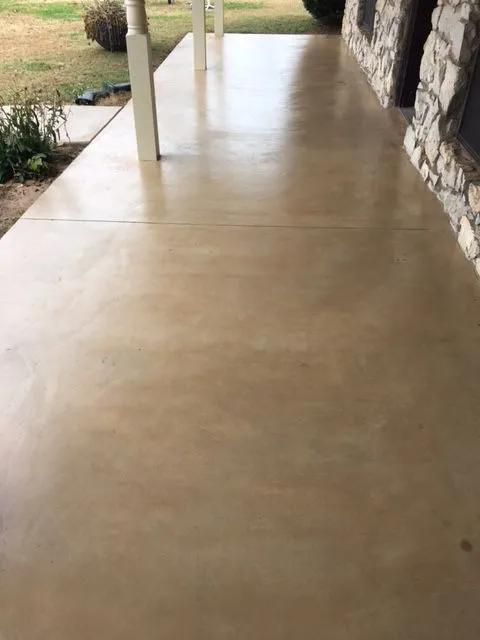
A plain broom-finished slab in south Louisiana does not have to be sealed. Stamped, colored and stained work does. If you choose to seal new concrete, wait about a month for it to cure, then wait for a dry stretch. How often to redo it depends on the product and the wear. Every few years is typical, more often for decorative surfaces and driveways. National figures for cleaning and sealing are $1 to $3 per square foot, or $575 to $1,700 for a two-car driveway.
Broom finish or smooth? What about a steep driveway?
Outside, choose a broom finish. A smooth trowel finish grows a slick film in our damp shade and is treacherous in rain. Keep smooth finishes for garage and shop floors. Steep drives are unusual on this flat ground, but ramps up to raised garages and raised houses are common since the 2016 flood, and those get a heavy broom texture across the slope.
What does a hot tub pad need?
A hot tub pad has to be level, thick enough for the load and seated on compacted base. Water is heavy, and a full tub with people in it puts a large load on a small area. The manufacturer's manual states the requirement, and we build to it. On clay that softens when wet, keep roof water and tub drainage away from the pad. Run the electrical conduit before the pour.
What does a shop slab need for a vehicle lift or heavy equipment?
Follow the lift maker's sheet. It gives a minimum thickness and concrete strength for the anchors, and often a minimum cure time before bolting. Tell us the model before we form. For a tractor, a loaded trailer or other heavy equipment, we look at wheel loads and may thicken the slab or the strip where the load sits. An engineer should size anything unusual.
Do I need gravel under a slab? Do I need a vapor barrier?
You need a compacted base. Whether that is crushed stone, gravel under the slab, sand or select fill depends on the site and what the slab carries. On our clay the base evens out support and keeps the slab off soil that changes with the weather. A vapor barrier belongs under any enclosed floor: house, garage, shop or shed. Clay holds moisture, and it rises through bare concrete. Open driveways and patios do not need one.
We get delivery trucks. What should that pad have?
A pad that takes a delivery truck needs a thicker section, heavier steel, closer joints and a strong base, especially at the entrance where trucks brake and turn. A slab built for cars will crack under repeated truck loads, and the first place to go is the edge by the road. Tell us the largest vehicle and how often it comes.
My pool deck is worn out. Resurface it, switch to pavers or pour new?
If the pool deck is level and solid, resurface it. The national figure is $3 to $6 per square foot. Sections that have sunk beside the pool are replaced after the backfill is compacted. Pavers are reasonable too and can be reset later. Choose a pale, textured surface whichever way you go, because dark smooth decks burn feet and slip.
The patio will be poured against the house. What goes in between?
An isolation joint, which some people call an expansion joint. It is a strip of compressible filler between the patio and the house slab, sealed on top. It lets the patio rise and fall with the clay without pushing on the house. Many newer homes here have post-tensioned slabs, so a patio must not be drilled and pinned into the house slab.
Want a real number for your property? We measure on site and write the quote down, free. Call (225) 529-0954 or text a photo of the concrete.